Fossilized Insect Found Preserved in Opal, a Rare 4–7 Million-Year-Old Discovery
A Prehistoric Anomaly: The Insect Entombed in Opal
For millions of years, amber has been the undisputed king of preserving ancient life, famously trapping everything from feuding insects to mid-air lizards in its hardened golden resin. But a stunning discovery from the Indonesian island of Java is challenging that monopoly: a perfectly preserved insect encased not in amber, but in precious opal.
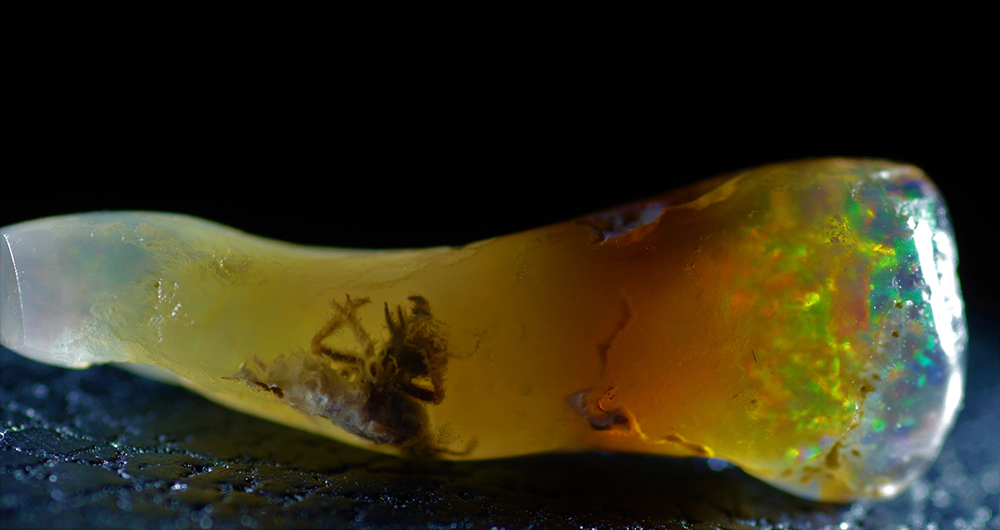
Gemologist Brian Berger recently acquired the remarkable gemstone, which is estimated to be between four and seven million years old. Flashing a brilliant rainbow of neon greens, dark blues, and vibrant reds, the stone is a geological marvel on its own. However, its true value lies in its prehistoric cargo.
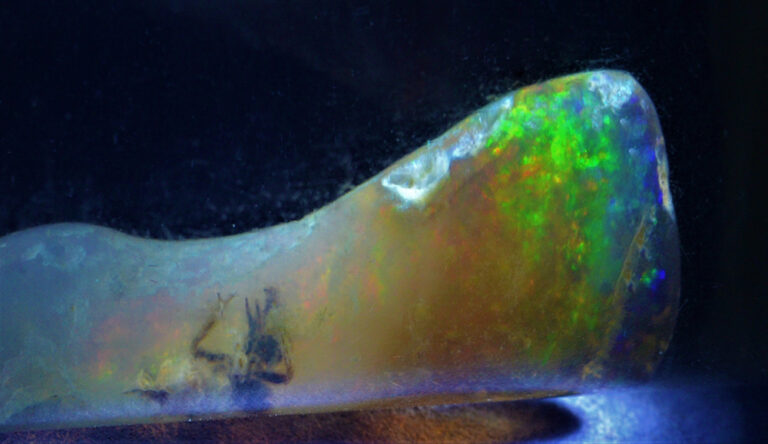
“You can see what appears to be a complete insect encased beautifully inside,” Berger wrote in Entomology Today. “The insect appears to have an open mouth and to be very well preserved, with even fibrous structures extending from the appendages.”
The Mystery of Formation
While opalized wood is relatively common in Indonesia, an insect perfectly preserved in opal is a scientific anomaly. It forces researchers to ask a difficult question: How did a fragile bug survive the intense process of turning into a gemstone?
Scientists are still debating the exact mechanics, but several theories have emerged:
-
The Standard Process: Typically, opals form when silica-rich water (or cooling volcanic fluid, which is common in Indonesia) flows into hollow cracks in the earth. As the liquid evaporates, it leaves behind silica deposits that eventually build up into an opal.
-
The Amber-to-Opal Theory: Some experts believe the bug was originally trapped in standard tree resin (amber), which then somehow underwent opalization.
-
The Cavity Contradiction: The major flaw in the amber theory is that opalization requires a hollow space to form. Solid amber does not provide a cavity, leaving scientists puzzled as to how the transition occurred.
-
The Hybrid Theory: Paleontologists suggest the specimen might have formed like certain types of petrified wood—perhaps the insect was only partially embedded in resin, while the exposed surrounding material underwent opalization over millions of years.
What Happens Next?
The Gemological Institute of America (GIA) has already authenticated the stone, confirming it is an “unaltered, untampered precious opal, with a genuine insect inclusion.”
Now, Berger is hoping to recruit entomologists and paleontologists to study the specimen in depth. If the amber-to-opal timeline is confirmed, this hapless prehistoric bug could be one of the oldest of its kind ever discovered—and it could fundamentally change how scientists look for ancient fossils.